Showing posts with label output. Show all posts

Wednesday, November 19, 2014

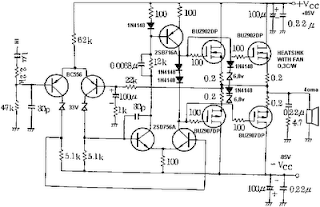
Mosfet Amplifier with power output 400W

See figure below its power amplifier using transistor mosfet as amplifier.
Mosfet
Mosfet Amplifier with power output 400W
Read More

Wednesday, October 1, 2014

How to Make an Adjustable Zener Diode Circuit with Stable Output

As everybody knows the voltage drop across a zener diode is dependent on the current passing th rough the diode.
Therefore, depending on the type and power of the device, there can be very noticeable deviations from the nominal zener voltage. This can be a problem, especially in circuits where a stable d.c. voltage is essential. The most logical way of solving the problem is to keep the current through the diode constant so that the zener voltage can not change. ln order that the load connected to the zener diode draws a constant current, the zener can be supplied by means of a current source. Then the current through the current source is made dependent on the zener voltage. In our adjustable zener circuit we use a zener diode with a zener voltage of 6 V. Other zener values could be used if resistors R1 . . . R4 are changed to suit another value. The maximum input voltage is mainly limited by the power which can be dissipated by T1 and T2. The d.c. input voltage must be at least as high as the sum of the zener voltages of Dl and D2.

The current source consisting of T1, R1 and D1 ensure that the current through D2 remains constant. Transistor T2, resistor R 2 and zener diode D2 in turn form a current source for zener D1 so that the current through this diode also stays constant. Diode D3 and the voltage divider, consisting of R3 and R4, ensure that this circuit can ’start’ (just as a thyristor made of transistors). As soon as the voltage is switched on a current flows through D3 causing T2 (and therefore T1) to conduct. The value of R3 must be selected such that diode D3 blocks as soon as the voltage across the zener dlode has stabilized. So care must be taken that the voltage at the anode of D3 ls less than the zener voltage of D2 plus the di0de’s own voltage drop of 0.6 V. This is defined by the formule: ; x U;


Read More

Thursday, September 18, 2014

Negative Output Switching Regulator

There are only a limited number of switching regulators designed to generate negative output voltages. In many cases, it’s thus necessary to use a switching regulator that was actually designed for a positive voltage in a modified circuit configuration that makes it suitable for generating a negative output voltage. The circuit shown in Figure 1 uses the familiar LM2575 step-down regulator from National Semiconductor (www.national.com). This circuit converts a positive-voltage step-down regulator into a negative-voltage step-up regulator. It converts an input voltage between –5 V and –12 V into a regulated –12-V output voltage.

Note that the output capacitor must be larger than in the standard circuit for a positive output voltage. The switched current through the storage choke is also somewhat higher. Some examples of suitable storage chokes for this circuit are the PE-53113 from Pulse (www.pulseeng.com) and the DO3308P-153 from Coilcraft (www.coilcraft.com). The LM2575-xx is available in versions for output voltages of 3.3V, 5 V, 12 V and 15 V, so various negative output voltages are also possible. However, you must pay attention to the input voltage of the regulator circuit. If the input voltage is more negative than –12 V (i.e., Vin <–12 v), the output voltage will not be regulated and will be lower than the desired –12 v.

Negative-Output
The LM2575 IC will not be damaged by such operating conditions as long as its maximum rated input voltage of 40 V is not exceeded. High voltage (HV) types that can withstand up to 60 V are also available. Although the standard LM2575 application circuit includes circuit limiting, in this circuit the output current flows via the diode and choke if the output is shorted, so the circuit is not short-circuit proof. This can be remedied by using a Multifuse (PTC) or a normal fuse. There is also an adjustable version of the regulator with the type designation LM2575-ADJ (Figure 2). This version lacks the internal voltage divider of the fixed-voltage versions, so an external voltage divider must be connected to the feedback (FB) pin. The voltage divider must be dimensioned to produce a voltage of 1.23 V at the FB pin with the desired output voltage. The formula for calculating the output voltage is:

Vout = 1.23 V × (1 + [R1 ÷ R2])

The electrolytic capacitors at the input and output must be rated for the voltages present at these locations.
Read More

Monday, September 15, 2014

PHILCO PHILIPS PH32S86DG – LED LCD TV POWER SUPPLY REGULATOR and AUDIO OUTPUT SCHEMATIC


Power Supply Regulator Circuit & Audio Output schema_ PHILCO [PHILIPS] PH32S86DG – LED LCD TV 

ICs used [TPA3020 (Audio Output) – D7537R (Power Control)
SMPS SCHEMATIC
AUDIO OUTPUT SCHEMATIC
CLICK ON THE SCHEMATICS TO MAGNIFY

Read More

Saturday, August 30, 2014

Combine stereo input to one output

Here , I will give a circuit of schemes that are used to combine 2 pieces input or stereo to 1 input mono. Why 2 inputs in to one because, if we need a stereo amplifier we want to become a stronger by combining the two input into one input, so that a higher power output. Actually without any circuit above we can combine stereo amplifier into mono, but the sound output less than the maximum , need for this additional combiner circuit.
 btl amplifier
Part List =
R1______150K
R2______920R
R3______150K
R4______920R
R5______920R
U1______NE5532

For balance _: R1 / R2=R3 / R4
For balance _: R1 = R3
Gain ______: R5 / R1 = R5 / R3
Read More

Sunday, August 17, 2014

TDA9302 Vertical deflection output schematics

The TDA9302H is a monolithic integrated circuit in HEPTAWATTTM package. This is a high efficiency power amplifier for direct drive vertical rolls from the yokes of TV. This is intended to be used in Color and B & W television as well as in monitors and displays .
tda9302H
Pin Connection :
 datasheet tda9302h

Supply Voltage pin 2                                35V
Flyback peak voltage                               60V
Voltage at pin 3                                        +Vs
Amplifier Input Voltage                           -0.5V
Deflection Output Current                       ± 1.8 A
Pin 3 DC Current at V5 < V2                  100 mA
Total Power Dissipation at Tcase             90 °C
Storage and Junction Temperature          – 40, +150°C


Part List :

Resistor
R1 = 12K
R2 = 10K
R3 = 27K
R4 = 12K
R5 = 1R
R6 = 330R
R7 = 1.5R
Ry = 5.9R

Capacitor 
C1 = 680mF
C2 = 220uF
C3 = 220uF
C4 = 0.22uF
C5 = 1000uF
C6 = 4.7uF


Diode
D1 = BY252

IC = TDA9302H
Read More