
Showing posts with label charger. Show all posts
Showing posts with label charger. Show all posts
Friday, December 12, 2014
Tuesday, November 4, 2014
Normally, chargers available in the market do not have any sort of control except for a ro-tary switch that can select different tap-pings on a rheostat, to vary the charging current. This type of control is not adequate because of the irregular fluctuations in the mains supply, rendering the control ineffective. A simple circuit intended for automatic charging of lead-acid batteries is presented here. It is flexible enough to be used for large capacity inverter batteries. Only the rating of transformer and power transistor needs to be increased.
Automatic Battery Charger Circuit Diagram:

The circuit has been basically designed for a car battery (about 40 Ah rating), which could be used for lighting two 40W tube lights. The circuit includes Schmitt trigger relay driver,float charger,and battery voltage monitor sections. The Schmitt trigger is incorporated to avoid relay chattering. It is designed for a window of about 1V. During charging, when the battery voltage increases be-yond 13.64V, the relay cuts off and the float charging section continues to work. When battery voltage goes below 11.66V, the relay is turned on and direct (fast) charging of the battery takes place at around 3A. In the Schmitt trigger circuit, resistors R1 and R2 are used as a simple voltage divider (divide-by-2) to provide battery voltage sample to the inverting input terminal of IC1. The non-invert-ing input terminal of IC1 is used for reference input derived from the output of IC2 (7806), using the potentiometer arrangement of resistors R3 (18 kilo-ohm) and R4 (1 kilo-ohm).
LED1 is connected across relay to indicate fast charging mode. Diodes D3 and D6 in the common leads of IC2 and IC3 respectively provide added protecion to the regulators. The float charging section, comprising regulator 7812, transistors T3 and T4, and few other discrete components, becomes active when the battery volt-age goes above 13.64V (such that the relay RL1 is deenergised). In the energised state of the relay, the emitter and collector of transistor T4 remain shorted, and hence the float charger is ineffective and direct charging of battery takes place.
The reference terminal of regulator (IC3) is kept at 3.9V using LED2, LED3, and diode D6 in the common lead of IC3 to obtain the required regulated output (15.9V), in excess of its rated output, which is needed for proper operation of the circuit. This output voltage is fed to the base of transistor T3 (BC548), which along with transistor T4 (2N3055) forms a Darlington pair. You get 14.5V output at the emitter of transistor T4, but because of a drop in diode D7 you effectively get 13.8V at the positive terminal of the battery. When Schmitt trigger switches ‘on’ relay RL1, charging is at high current rate (boost mode). The fast charging path, starting from transformer X2, comprises diode D5, N/O contacts of relay RL1, and diode D7.
The circuit built around IC4 and IC5 is the voltage monitoring section that provides visual display of battery voltage level in bar graph like fashion. Regulator 7805 is used for generating reference voltage. Preset VR1 (20 kilo-ohm) can be used to adjust voltage levels as indicated in the circuit. Here also a pot meter arrangement using resistors R7, R8, and R9 is used as ‘divide by 3’ circuit to sample the battery voltage. When voltage is below 10V, the buzzer sounds to indicate that the safe dis-charge limit has been exceeded.
Saturday, November 1, 2014
The circuit below will trickle charge a four cell pack of AA or AAA NiMH batteries. The circuit draws current from the +5v available a USB connection and pumps about 70ma of current into the battery. This should be enough current to fully charge a pack of 2500ma-hour cells in about 36 hours. The circuit uses a single 74HC14 hex Schmitt trigger inverter in conjunction with a voltage doubler charge pump circuit.
Source: DiscoverCircuits
Saturday, October 4, 2014

iPod Battery Charger Circuit Diagram
Read More
This is the iPod Battery Charger Part list:
P1 = 1K
R1 = 1R-0.5W
R2 = 1R-0.5W
R3 = 1R-0.5W
R4 = 1K
R5 = 560R
R6 = 10R-0.5W
R7 = 470R
C1 = 470uF-25V
C2 = 100nF-63V
C3 = 470pF
C4 = 100uF-25V
D1 = 1N5404
D2 = TVS1P6KE27A
D3 = 1N5819
D4 = 5.1V-1W Zener Diode
D5 = 5mm. Red LED
L1 = 220uH
S1 = USB A Type Socket
SW1 = On/Off Switch
IC1 = MC34063A
P1 = 1K
R1 = 1R-0.5W
R2 = 1R-0.5W
R3 = 1R-0.5W
R4 = 1K
R5 = 560R
R6 = 10R-0.5W
R7 = 470R
C1 = 470uF-25V
C2 = 100nF-63V
C3 = 470pF
C4 = 100uF-25V
D1 = 1N5404
D2 = TVS1P6KE27A
D3 = 1N5819
D4 = 5.1V-1W Zener Diode
D5 = 5mm. Red LED
L1 = 220uH
S1 = USB A Type Socket
SW1 = On/Off Switch
IC1 = MC34063A
Using the USB port on your computer to charge your player’s batteries is not always practical. What if you do not have a computer available at the time or if you do not want to power up a computer just for charging? Or what if you are traveling? Chargers for Mobile Phones iPods and MP3 players are available but they are expensive and you need separate models for charging at home and in the car.
This charger can be used virtually anywhere. While we call the unit a charger, it really is nothing more than a 5V supply that has a USB outlet. The actual charging circuit is incorporated within the iPOD or MP3 player itself, which only requires a 5V supply. As well as charging, this supply can run USB-powered accessories such as reading lights, fans and chargers, particularly for mobile phones.
The supply is housed in a small plastic case with a DC input socket at one end and a USB type "A" outlet at the other end, for connecting to Mobile Phone, an iPod or MP3 player when charging. A LED shows when power is available at the USB socket. Maximum current output is 660mA, more than adequate to run any USB-powered accessory.
This charger can be used virtually anywhere. While we call the unit a charger, it really is nothing more than a 5V supply that has a USB outlet. The actual charging circuit is incorporated within the iPOD or MP3 player itself, which only requires a 5V supply. As well as charging, this supply can run USB-powered accessories such as reading lights, fans and chargers, particularly for mobile phones.
The supply is housed in a small plastic case with a DC input socket at one end and a USB type "A" outlet at the other end, for connecting to Mobile Phone, an iPod or MP3 player when charging. A LED shows when power is available at the USB socket. Maximum current output is 660mA, more than adequate to run any USB-powered accessory.
Wednesday, September 17, 2014
There is a wide variety of NiCd (nickel-cadmium) battery chargers on the market, but there are not many that can work from an in car 12 V cigar lighter. Such a charger would, for instance, be of interest to campers and caravanners who do not have a 230 V a.c. mains supply available. To satisfy the needs of these users, a charger could be designed for operation from the cigar lighter, but it is, of course, of far greater interest if it could also work from the domestic mains supply. Furthermore, it would also be very useful if a number of cells, say, 1 to 4, of different format could be charged simultaneously.
Lastly, another benefit would be if the charger would automatically switch off once the battery or cells have been charged fully. The charger described in this article does all that: it accommodates batteries or cells Type R6 and R14. Switching off after a period of 2 h 30 m, 5 h, or 10 h is arranged by 3-way switch S1. The 2 h 30 m period is for charging Type R6 batteries (1/2 charge), the 5 h period for fully charging Type R6 batteries or half charging Type R14 batteries, and the 10 h period for fully charging Type R14 batteries. Light-emitting diode D1 lights when charging is taking place. Charging after the set period has elapsed can be continued, if so desired, only by switching the supply off and then on again.
 The time periods are determined by counters IC1 and IC2, Type 4060 and 4020 respectively. The 4060 has an integral oscillator, whose frequency is set to 932 Hz with preset P1 and the aid of a frequency meter. For various reasons, such as the values of the components used and parasitic elements, the oscillator itself operates at a slightly higher frequency – of the order of 1 kHz. The frequency of the signal at the wiper of P1 is divided by 214, so that the frequency of the signal at Q13 of IC1 is 0.056 Hz, equivalent to a pulse every 17.6 s. The signal at Q13 is applied to the input, pin 10, of IC2. When switch S1 is in position 2 h 5 m (output Q10 of IC2), the divisor should be 210 (1024).
However, contrary to what these figures indicate, the time period stops at half that at output Q10. To obtain a charging period of 2 h 30 m, that is, 9,000 seconds, which should correspond to half a period at output Q9 of IC2, the oscillator period must be 9000×2/16.7×106=1.073 ms, which corresponds to a frequency of 932 Hz as mentioned earlier. On power-on, only counter IC2 is reset, since an error of a few seconds that may arise in IC1 is of no significance. This arrangement simplifies the design. When the time set has elapsed, that is, charging is finished, diode D1 goes out.
The charging current is fixed by darlington transistor T3, which is a classical design of a current source with negative feedback. The transistor tends to hold its emitter potential at 1.3 V, but this requires the aid of a zener diode, D2. In this type of design, the thermal stability is, in fact, totally acceptable, because the temperature of the zener diode, in view of the small current this draws and its consequent low temperature rise, hardly affects the charging current Transistor T1 is either on or off and serves to power the on/off indicator LED. It is needed to prevent an overload on the output of counter IC1 if this would be required to absorb the total current (about 7mA) drawn by the diode.
Transistor T2 discontinues the charging when the time set by S1 has elapsed by earthing the base of darlington T3. Diodes D3–D14 are connected in threesomes across the terminals of the batteries to be charged: D3–D5 across those of battery Bt1, D6–D8 across those of Bt2, and so on. Diode D15 prevents the batteries to be charged from being discharged when the supply fails. When the charger is used in a vehicle, additional precautions should be taken to ensure that any spurious surges on the vehicle power lines do not adversely affect the charger’ s operation. The battery holder should be one that can accommodate four size R6 (AM3; MN1500; SP/HP7; mignon) or R14 AM2; MN1400; SP/HP11; baby) batteries.
The length of these batteries, but not their diameter, is the same (about 45 mm). When the charger is used at home, it may be powered via a suitable 15V mains adaptor. It draws a current of about 150mA. A final word of warning: it is possible for batteries to be connected to the charger with incorrect polarity. This may result in a very large discharge current and even destruction of the battery. It is, therefore, imperative to verify the correct polarity of the battery before inserting it into the holder.
Read More
Lastly, another benefit would be if the charger would automatically switch off once the battery or cells have been charged fully. The charger described in this article does all that: it accommodates batteries or cells Type R6 and R14. Switching off after a period of 2 h 30 m, 5 h, or 10 h is arranged by 3-way switch S1. The 2 h 30 m period is for charging Type R6 batteries (1/2 charge), the 5 h period for fully charging Type R6 batteries or half charging Type R14 batteries, and the 10 h period for fully charging Type R14 batteries. Light-emitting diode D1 lights when charging is taking place. Charging after the set period has elapsed can be continued, if so desired, only by switching the supply off and then on again.
 The time periods are determined by counters IC1 and IC2, Type 4060 and 4020 respectively. The 4060 has an integral oscillator, whose frequency is set to 932 Hz with preset P1 and the aid of a frequency meter. For various reasons, such as the values of the components used and parasitic elements, the oscillator itself operates at a slightly higher frequency – of the order of 1 kHz. The frequency of the signal at the wiper of P1 is divided by 214, so that the frequency of the signal at Q13 of IC1 is 0.056 Hz, equivalent to a pulse every 17.6 s. The signal at Q13 is applied to the input, pin 10, of IC2. When switch S1 is in position 2 h 5 m (output Q10 of IC2), the divisor should be 210 (1024).
However, contrary to what these figures indicate, the time period stops at half that at output Q10. To obtain a charging period of 2 h 30 m, that is, 9,000 seconds, which should correspond to half a period at output Q9 of IC2, the oscillator period must be 9000×2/16.7×106=1.073 ms, which corresponds to a frequency of 932 Hz as mentioned earlier. On power-on, only counter IC2 is reset, since an error of a few seconds that may arise in IC1 is of no significance. This arrangement simplifies the design. When the time set has elapsed, that is, charging is finished, diode D1 goes out.
The charging current is fixed by darlington transistor T3, which is a classical design of a current source with negative feedback. The transistor tends to hold its emitter potential at 1.3 V, but this requires the aid of a zener diode, D2. In this type of design, the thermal stability is, in fact, totally acceptable, because the temperature of the zener diode, in view of the small current this draws and its consequent low temperature rise, hardly affects the charging current Transistor T1 is either on or off and serves to power the on/off indicator LED. It is needed to prevent an overload on the output of counter IC1 if this would be required to absorb the total current (about 7mA) drawn by the diode.
Transistor T2 discontinues the charging when the time set by S1 has elapsed by earthing the base of darlington T3. Diodes D3–D14 are connected in threesomes across the terminals of the batteries to be charged: D3–D5 across those of battery Bt1, D6–D8 across those of Bt2, and so on. Diode D15 prevents the batteries to be charged from being discharged when the supply fails. When the charger is used in a vehicle, additional precautions should be taken to ensure that any spurious surges on the vehicle power lines do not adversely affect the charger’ s operation. The battery holder should be one that can accommodate four size R6 (AM3; MN1500; SP/HP7; mignon) or R14 AM2; MN1400; SP/HP11; baby) batteries.
The length of these batteries, but not their diameter, is the same (about 45 mm). When the charger is used at home, it may be powered via a suitable 15V mains adaptor. It draws a current of about 150mA. A final word of warning: it is possible for batteries to be connected to the charger with incorrect polarity. This may result in a very large discharge current and even destruction of the battery. It is, therefore, imperative to verify the correct polarity of the battery before inserting it into the holder.
Read More
Saturday, September 13, 2014


# Dont connect your panel to the schema with out diodes
# Build this schema on a PCB Read More
Basically the circuit designed above have a very simple way of working, where the circuit is designed so that does not happen short circuit or short circuit between the voltage supply with batteries that will be in-charge.
![Automatic]()
It is true that if any one wants to try to direct mengghubungkan between supply with batteries then the batteries can be sure will be filled. But the current flowing through a charged battery can not be controlled and if the battery is full, the batteries will be damaged or worn out if it remains on the short circuit condition.
Working Principle Battery Charger
By the time we put an empty battery charging terminals, transistor Q1 will be activated immediately because the current flows through R1 and would trigger a transistor Q1 base. In this condition the flow that would fill the batteries mostly comes from the collector of Q1 is connected directly to the positive terminal of supply. Then during the charging process increases the battery voltage will increase the current flowing in Q2 base via 10 Kohm R5, VR1 and diode D2. VR1 is a component that is used as an initial calibration to determine the exact position in the planning process of switching circuit. For VR1 you can use a trimpot or potensio according to your taste. At the beginning of filling, arrange potensio at position D3 LED indicators on the condition of death, and the current flowing into the collector of Q1 is not too big and not too small.
If the battery is fully charged, the LED indicator will light up automatically because of an increase in voltage on the battery charge will cause the increase of current flowing at the base of transistor Q2 and will terminate the charging cycle due to transistor Q1 having a cut-off due to lack of base current. Why on condition Q1 base current will experience a shortage of this is because almost all the current flowing in R1 10 Kohm will switch to a diode D1 which is logically connected directly with ground experience due Q2 saturated.
.
Component List
1. Resistors: R1 (10 Kohm), R2 (680 ohms), R3 (100 Kohm), R5 (10 Kohm) and VR1 (Potensio / trimpot = 100 Kohm)
2. Diodes: D1 & D2 (IN4002) and D3 (Led)
3. Transistors: Q1 and Q2 (2N3904)
4. 9 volt power supply
Read More
By the time we put an empty battery charging terminals, transistor Q1 will be activated immediately because the current flows through R1 and would trigger a transistor Q1 base. In this condition the flow that would fill the batteries mostly comes from the collector of Q1 is connected directly to the positive terminal of supply. Then during the charging process increases the battery voltage will increase the current flowing in Q2 base via 10 Kohm R5, VR1 and diode D2. VR1 is a component that is used as an initial calibration to determine the exact position in the planning process of switching circuit. For VR1 you can use a trimpot or potensio according to your taste. At the beginning of filling, arrange potensio at position D3 LED indicators on the condition of death, and the current flowing into the collector of Q1 is not too big and not too small.
If the battery is fully charged, the LED indicator will light up automatically because of an increase in voltage on the battery charge will cause the increase of current flowing at the base of transistor Q2 and will terminate the charging cycle due to transistor Q1 having a cut-off due to lack of base current. Why on condition Q1 base current will experience a shortage of this is because almost all the current flowing in R1 10 Kohm will switch to a diode D1 which is logically connected directly with ground experience due Q2 saturated.
.
Component List
1. Resistors: R1 (10 Kohm), R2 (680 ohms), R3 (100 Kohm), R5 (10 Kohm) and VR1 (Potensio / trimpot = 100 Kohm)
2. Diodes: D1 & D2 (IN4002) and D3 (Led)
3. Transistors: Q1 and Q2 (2N3904)
4. 9 volt power supply
Tuesday, August 26, 2014
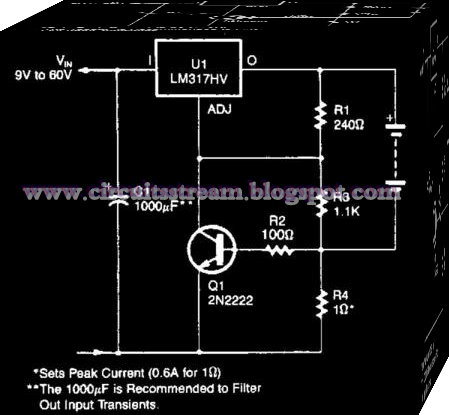
This is the Simple Current-Limited 6-V Charger Circuit Diagram. An LM317HV regulator is used as a current-limited charger. If current through R4 exceeds 0.6 A, Ql is biased on which pulls the ADJ terminal of the LM317 HV to ground and reduces the battery-charging current.
Simple Current-Limited 6-V Charger Circuit Diagram
Sunday, August 24, 2014
The electric fence charger schema presented here is basically a high voltage pulse generator. The super high voltage is derived from a commonly used automobile ignition coil. An a stable multivibrator is used to generate the required frequency to drive the ignition coil. Another a stable is used to control the pulses supplied to the fence.
If you have large agricultural fields and desperately need to protect the crops from uninvited guests like animals and possibly humans, then this electric fence charger device is just what you are looking for. Build and install it yourself. An electric fence is an electrified high voltage barrier which produces painful shocks if physically touched or manipulated. Thus such fencing basically function as deterrents for animals as well as human intruders and stop them from crossing the restricted boundary.
![Build]()
![Build]()
The present schema of an electric fence charger is designed and tested by me and has proved sufficiently powerful for the application. The schema is able to produce voltage pulses up to 20,000 volts, needless to say about the fatality rate involved with it. However the pulses being intermittent, provides the subject with enough time to realize, recover and eject.
The generated pulse is so powerful that it can easily arc and fly-off between short distances of around a cm. so the fencing conductor needs to be separated adequately to avoid leakages through arcing and sparking. If not tackled, may drastically reduce the effectiveness of the unit.
Here the generation of high voltage is primarily carried out by an automobile ignition coil.
The winding ratios of an ignition coil are specifically designed and intended for creating high voltage arc between a two closely spaced conductors inside the ignition chamber to initiate the ignition process in vehicles.
Basically it’s just a step-up transformer, which is able to step-up an input applied voltage at its primary winding to monstrous levels at its output or the secondary winding.
SOME POINTS OF THE CIRCUIT AND THE IGNITION COIL IS VERY DANGEROUS TO TOUCH WHEN POWERED. ESPECIALLY THE IGNITION COIL OUTPUT IS TOO LETHAL AND MAY EVEN CAUSE PARALYSIS.
Let’s diagnose the whole thing more deeply.
Circuit Description
If you have large agricultural fields and desperately need to protect the crops from uninvited guests like animals and possibly humans, then this electric fence charger device is just what you are looking for. Build and install it yourself. An electric fence is an electrified high voltage barrier which produces painful shocks if physically touched or manipulated. Thus such fencing basically function as deterrents for animals as well as human intruders and stop them from crossing the restricted boundary.
The present schema of an electric fence charger is designed and tested by me and has proved sufficiently powerful for the application. The schema is able to produce voltage pulses up to 20,000 volts, needless to say about the fatality rate involved with it. However the pulses being intermittent, provides the subject with enough time to realize, recover and eject.
The generated pulse is so powerful that it can easily arc and fly-off between short distances of around a cm. so the fencing conductor needs to be separated adequately to avoid leakages through arcing and sparking. If not tackled, may drastically reduce the effectiveness of the unit.
Here the generation of high voltage is primarily carried out by an automobile ignition coil.
The winding ratios of an ignition coil are specifically designed and intended for creating high voltage arc between a two closely spaced conductors inside the ignition chamber to initiate the ignition process in vehicles.
Basically it’s just a step-up transformer, which is able to step-up an input applied voltage at its primary winding to monstrous levels at its output or the secondary winding.
SOME POINTS OF THE CIRCUIT AND THE IGNITION COIL IS VERY DANGEROUS TO TOUCH WHEN POWERED. ESPECIALLY THE IGNITION COIL OUTPUT IS TOO LETHAL AND MAY EVEN CAUSE PARALYSIS.
Let’s diagnose the whole thing more deeply.
Circuit Description
In the CIRCUIT DIAGRAMwe see that the entire schema is basically comprised of four stages.
A DC oscillator stage, An intermediate 12 to 230 volts step-up stage, The voltage collector and firing stage and The super high voltage-booster stage.
TR1 and TR2 are two normal step-down transformers whose secondary windings are connected through SCR2. TR2’s input primary winding may be selected as per the country specification.
However, TR1’s primary should be rated at 230 volts.
IC1 along with the associated components forms a normal astable multivibrator stage. The supply voltage to the schema is derived from the secondary of TR2 itself.
The output from the astable is used to trigger SCR2 and the whole system, at a particular fixed intermittent rate as per the settings of P1.
During the ON periods, SCR2 connects the 12 volt AC from TR2 to the secondary of TR1 so that a 230 volt potential instantly becomes available at the other end of TR1.
This voltage is fed to the voltage-firing stage consisting of the SCR1 as the main active component along with a few diodes, resistor and the capacitor C4.
The fired voltage from SCR1 is dumped into the primary winding of the ignition coil, where it is instantly pulled to a massive 20,000 volts at its secondary winding. This voltage may be suitably terminated into the fencing.
The high voltage generated by this electric fence charger will need to be carefully applied across the whole length of the fence.
The two poles from the ignition coil connected to the fence wiring should be kept at least 2 inches apart.
The pillars of the fence should be ideally made of plastic or similar non conducting material, never use metal and not even wood (wood tend to absorb moisture and may give path to leakages).
Parts List
R4 = 1K, 1WATT,
R5 = 100 OHMS, 1WATT,
P1 = 27K PRESET
C4 = 105/400V PPC,
ALL DIODES ARE 1N4007,
IC = 555
TR1 = 0-12V/3Amp (120 or 230V)
TR2 = 0-12V/1Amp (120 or 230V)
BOTH THE SCRs ARE C106 OR PREFERABLY BT151,
TWO WHEELER IGNITION COIL IS SHOWN IN FLUORESCENT BLUE COLOR
Author Swagtam
Saturday, August 23, 2014
This is a Simple Wind battery Charger Circuit Diagram. The dc motor is used as a generator with the voltage output being proportional to its rpm. The LTC1042 monitors the voltage output and provides the following control functions. If generator voltage output is below 13.8 V, the control schema is active and the Ni-Cad battery is charging through the LM334 current source. The lead acid battery is not being charged.
If the generator voltage output is between 13.8 V and 15.1 V, the 12 V lead acid battery is being charged at about 1 amp/hour rate (limited by the power FET). If generator voltage exceeds 15.1 V (a condition caused by excessive wind speed or 12 V battery being fully charged) then a fixed load is connected limiting the generator rpm to prevent damage. This charger can be used as a remote source of power where wind energy is plentiful such as on sailboats or remote radio repeater sites. Unlike solar powered panels, this system will function in bad weather and at night.
Simple Wind battery Charger Circuit Diagram
Wednesday, August 20, 2014
This circuit can be used to charge Accu and cells battery , the circuit can has a very stable output that would make the battery last longer and maximize the added battery capacity. When charge was also quite fast , so it can optimize the time.

Read MoreA diac is used in the gate circuit to provide a threshold level for firing the triac . C3 and R4 provide a transient suppression network. R1 , R2 , R3 , C1 , and C2 provide a hase - shift network for the signal being applied to the gate. R1 is selected to limit the maximum charging current at full rotation of R2.
Subscribe to:
Posts (Atom)


