Showing posts with label amplifier. Show all posts

Monday, January 26, 2015

DC Coupled Audio Amplifier

Designs for audio amplifiers with DC coupling to the load are not often encountered these days, even though they offer definite advantages. One advantage is that there is no need for the complication of a second (symmetric) power supply; another is good frequency and phase response. Also, no special electrolytic capacitors are needed for voltage stabilisation, and switch-on ‘thump’ is much reduced. To try to rescue this class of circuit from obscurity the author has designed a headphone amplifier working along the lines illustrated in Figure 1.

DC-Coupled Audio Amplifier Circuit Diagram


It consists of a voltage divider, a voltage follower and the loudspeaker in the headphones, whose other side is connected to the junction of two electrolytic capacitors, providing the virtual earth. The potential at this point is, of course, half the supply voltage. All we need to do now is suitably couple in the audio signal to be amplified. Figure 2 shows a practical realisation of this idea in the form of a stereo headphone amplifier. The amplifier itself consists of IC1 and P1, R3 and R4 (giving a gain of 11).

DC Coupled Audio Amplifier Circuit Diagram


This part of the circuit demands no further explanation, and the same goes for the voltage divider mentioned above, formed by R1a and R1b. The signal is coupled in via the potentiometers. C2 and R2 have a special purpose: C2 connects the bottom end of the potentiometers (ground for the input signal) to the virtual earth. However, this capacitor creates a feedback path which can lead to oscillation of the amplifier under some circumstances. R2 damps this tendency to oscillate.
 
It is possible to calculate suitable values for these components, but it is better to determine them by experiment. C2 must be sufficiently large that stray electric fields do not cause unacceptable hum at the output. R2 must be sufficiently large that the voltage at the amplifier’s virtual earth stabilises quickly enough after switch-on. The polarity of the electrolytic is unimportant as no significant voltage appears across the network. It is possible to try the circuit out with the C2/R2 network shorted and observe the behaviour of the circuit at switch-on using an oscilloscope. Depending on the degree of asymmetry in the circuit, the voltage at the virtual earth point can take a considerable time to stabilise.


Read More

Thursday, November 20, 2014

High Impedance amplifier circuits

Mini High Impedance Amplifier is an amplifier with 1 Watt and have a very high input impedance. The series amplifiers can have a very high input impedance because the use of two transistors in the input that is placed Darlington. Input impedance circuit amplifier achieves 20M Ohm. Mini High Impedance Amplifier circuit uses four transistors and an IC 741. Gain amplifier with high input impedance , we can provide the input signal from device with weak levels though.

High

Mini High impedance amplifier circuit is very cheap to make and quite simple. This amplifier circuit use 9VDC power supply.
Read More

Wednesday, November 19, 2014

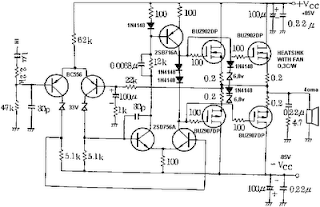
Mosfet Amplifier with power output 400W

See figure below its power amplifier using transistor mosfet as amplifier.
Mosfet
Mosfet Amplifier with power output 400W
Read More

Tuesday, November 18, 2014

Schematic Audio Amplifier Circuit 200W

Output Power : 200Watts
Load Resistance : 8ohms
Input impedance : 55K
Maximum supply voltage : (+95v)-0-(-95v)
Recommended supply voltage : (+66v)-0-(-66v)

This complete aerial quality, low babble address audio ability amplifier is based about the Hybrid Integrated Ambit STK4050 bogus by Sanyo. The ambit incorporates aggregate and has a best music achievement ability of 200W.The ambit incorporates an on lath ability supply; therefore, alone centre broke agent is appropriate to ability the circuit. I t has actual acceptable affection sound. U can use it with your Home Theatre your PC & etc... You can additionally use it as Subwoofer Amplifier.

It is a bunched amalgamation for THIN-TYPE Audio sets. Easy Heatsink architecture to banish calefaction generated in THIN-TYPE audio sets. Constant-Current ambit to Reduce accumulation switch-ON and switch-OFF shock noise. External accumulation switch-On and switch-OFF shock babble muting, Load circumlocute protection, thermal abeyance and added circuits can be tailored-designed.
Read More

Tips for Choosing a quality Power Amplifier

Here are some tips you need to note:
1. Pick of the power that suits your needs. For personal use such as exercise, etc., is sufficient to choose an amplifier with a power of 15-20 watts. In most small power amplifiers are already available facilities such as Head Phone jack (eg Guitar Amplifier Laser 20) which is very useful especially for young people who have a habit of playing music until midnight. By leveraging these channels to Head Phone, then secured another household or neighbors will not be disturbed our music sound. Sound good hasilnya.Apabila amplifier system we will use to train together in a full band with drums, etc., then you should choose a larger power amplifier that is 70 watts or above. Thus the sound produced from the amplifier and sound system will not be drowned by the sound of pounding and pounding beat Drum.Untuk use on stage, you will need a higher power that is at least 125 watts or more, because this amplifier will be able to once we use as a monitor of musical instruments were playing.

2. Choose the facilities we need. Do not buy amplifiers which have facilities that we do not really need when it is increasing the price we pay. Unless the same price we can get better facilities, there is no harm in our selection.

3. Choose a good quality amplifier. If we need an amplifier to your keyboard, then it is advisable to select an amplifier that does not change the color of the original sound generated by the keyboard musical instrument they will be (flat). There are many amplifiers that produce different sounds from the original sound, if this happens there will be other voices that would reduce the original character of the actual sound produced by the keyboard because of the addition or subtraction of a particular frequency. Usually this happens at a very low frequency (low bass) or very high frequency (high treble). (Try the sound system rental, sound rental service) For amplifiers Electric Guitar and Electric Bass this (flat characteristic) does not apply because it specifically for these two types of instruments are required specificity of character frequency. Basically for Electric Guitar amplifier output is not needed for low frequency and high. For Electric Bass needed a low frequency, but not required a high frequency. We can learn from the rental place and the sound system rental-quality musical instrument.

4. Model and performance amplifier can be considered final. The desired model will depend on individual taste. A good model according to a person, not necessarily a good thing according to those who lainnya.Pada most professional musicians model will be the last option or not too overlooked. They will be more concerned with the quality and facilities of the amplifier. Maybe we can find also in the rental services professional sound and musical instrument rental place bagus.Demikian brief tips on choosing an amplifier, hopefully this can help to determine the right choice before you buy an amplifier and produce sound quality music is also of course .

Tips for Choosing Quality Amplifier

1. Pick of the power to suit your sound system. For personal use such as exercise is sufficient to choose an amplifier with 1-20watt power. In most electronic devices / small power amplifiers are already available facilities such as head phone jack (eg laser20 guitar amplifier) ​​is very useful especially for young people who have a habit of playing music until midnight. By leveraging the channel for these headphones, then secured another household or neighbors will not be disturbed "attraction" we. If the amplifier sound system we will use to train together in a group full band * with drum and band instrument, then you should choose a power amplifier 70watt or above. Thus the sound produced from the amplifier will not be drowned by the sound of pounding and pounding drum beats. For use on stage, you will require more resources than most, namely at least 125watt or more, because this amplifier will be at the same we use as a monitor of musical instruments were playing.

2. Select the facilities we need. Do not buy a multimedia system / amplifier that has the facilities that we do not really need, if it is increasing the price we pay. Unless the same price we can get better facilities, there is no harm in our selection.

3. Choose a good quality amplifier. If we need an amplifier to your keyboard, then it is advisable to select an amplifier that does not change the original color generated by the keyboard (flat). There are many Indonesian musical instrument amplifier that produces a different sound from the original sound, if this happens there will be other voices that would reduce the original character of the actual sound produced by the keyboard because of the addition or subtraction of a certain frequency speaker system. Usually this happens at a very low frequency. (Low bass) or very high frequency (high treble). To Lighting System, Electric Amplifier Electric Bass Guitar and this (flat characteristic) does not apply because it specifically for these two types of instruments required specificity of character frequency. Basically for Electric Guitar not dipelukan amplifier output for low frequencies and high. For Electric Bass needed a low frequency, but not required a high frequency.

4. Models and appearance can be thought being given to the last amplifier. The desired model will depend on individual taste. A good model according to a person not necessarily a good thing by other people.
In most professional musicians, models will be the last option or not too overlooked. They will be more concerned with the quality and features of the amplifiers for musical instruments. But if you are confused, you could just rent equipment or hire sound system rental equipment.
Read More

Monday, November 17, 2014

Rangkaian Power Supply for tube amplifier

Power supply for EL-34 tube is specially designed for the purposes of power supply at the push-pull amplifier with EL-34 tube as in article 35 Watt Tube Power Amplifier Push Pull before.
Power supply for EL-34 tube amplifier is made with transformers CT and 2 pieces diode as rectifier. Mechanical filters are applied in the power supply uses 3 levels. Power supply for tube power amplifier can deliver output voltages +220 VDC. Circuit details can be seen in the following figure.


The above power supply circuit has a high output voltage so that need to be considered in the manufacture and perakitanya because electricity can tesengat (stun). Power Supply For Tube Power Amplifier With Diode EL-34 was created specifically for the power amplifier tube push pull EL-34.
Read More

Audio Power Amplifier 170W with LM4651 LM4652

AudioAudio Power Amplifier 170W with LM4651 & LM4652

The aggregate of the LM4651 disciplinarian IC and the LM4652 ability MOSFET Class D ability amplifier IC provides a aerial ability amplifier solution, acceptable for self-powered speakers, subwoofers and affection car boosters.

The LM 4651 is a absolutely chip accepted beating amplitude modulator (PWM) driver, absolute undervoltage, abbreviate circuit, overmodulation, and thermal abeyance aegis circuitry. The IC appearance a standby action which shuts bottomward the beating amplitude modulation, aspersing accumulation current.

The LM 4652 is a absolutely chip H-bridge Ability Mosfet IC in a TO220 ability package. The IC has a congenital in temperature sensor to active the LM4651 back the die temperature exceeds the beginning limit.

Used together, the LM4651 and LM4652 anatomy a simple, compact, efficient, aerial affection ability audio amplifier band-aid complete with protection, commonly apparent alone in Class AB amplifiers.

Read More

Tips and Tricks on Audio Power Amplifier Circuit

Amplilfier power series from the beginning until now did not experience any changes. Some say this series is good, but the series was good fitting assembly and tested the results are not as we expected.
The problem is usually treble is less subtle, less sound, sound breaking, buzz, middle of the field tested the bass sound is lost. so you do not have to believe what people 100%. The quality amplifier built-up would differ greatly with the amplifier assembly, a series can be the same but the quality will depend on who manufacture it.

Here are a few tricks to try

How to cope with a buzzing sound
Power amplifiers are often used in the field blazer. This circuit is said said person is a bell assembly. But you do not immediately interested in this power, the circuit rather complicated and difficult to understand reflect the intelligence of people who first mendisainnya. In my opinion a great power is the power of simple, inexpensive, easily assembled and rational. You do not need to use expensive components such as the price of tantalum capacitors, power mosfet and the other expensive. This does not determine the quality of the power amp so that we raft. Power of sometimes causing buzzing, to overcome that is by holding the line input jack ground to the ground with 10-22 ohm resistors. So do not just take the ground input from the ground but held first with the R 10 ohms.


How to setting bias trimpot
Rotate the trimpot bias (if any) until the drain current of 50-100mA on each power transistor, in order to avoid defects treble in volume in the top position at 10. The risks are so panassss heatsink! (This setting marks on plate A-AB)

Offset trimpot setting
At the time of input without a signal, turn the trimpot so that the voltage on the speaker offsets actually read 0 volts. If you do not want to bother, use and entrust it with ic type series from Hitachi HA17741 IC brand quality or other! This is the heart of the series, 90-95% of quality is determined from the IC circuit this!

Overcoming the voice
Use pre-amp circuit to increase the signal of at least 2 times. normally and should pre-amp circuit uses IC op-amps with +12 V minimum supply-12V. Raise his mid tone!
If hard you do not want to just use the tone control circuit IC is his mid!
The secret is not in his mid tone alone, but the signal output from the IC op-amps are usually large.

Treble rupture
Excessive treble will damage the power amp, power rather than out even ngedrop. Handle, attach the filter capacitor on the input 1NF power amp to ground to ensure the signal is not disabled. Always use a quality active components such as ICs and transistors, 500 price difference will also be different results.
Use a large cable and short as possible, especially for leg power transistor, and this transistor should be directly soldered to the pcb.

Missing bass in field
Usually power for field use supplay CT 50V 50V transformer, or at least 42V 42V ct. The greater the greater the supply voltage watt channeled though the series is written only 300-400 Watts only. This course uses Elko capacitors with voltage 80-100V. 10.000uF/100V capacitor will be equal to 4X10.000uF/50V and of course voltage capacitor is filled with full / almost full.
Try to use a strong Elko at temperatures of 105 C. Capacitors are strong in supply of more than nominal voltage is written on his body. For example 4700uF/50V 85C capacitor will quickly explode in voltage 51V 85C. And Elko will be strong 105C 4700uF/50V voltage supplied more than 50V at a temperature of 85C. Elco so that it does not quickly explode if given the full voltage, keep its temperature as cold as possible, fan with the cool air.

For speaker
Try using a driver speakers that have a large spool diameter fitted with a suitable size bok. Usually included examples of the parameters / dimensions bok. Size bok bok2 usually larger than that sold in the market. if you force using bok that from this market, use driver type G12-80 (sorry no fear brand called promotion) speakers with bass tones to wall size small. Bok wall should be thick, strong and do not forget glued! Bok who will not be glued with a different sound, especially bass tones, prove it!

Heat Sensor
The form of transistor, the transistor is usually type BD139 MJE340 or it could be located in the center, flanked by a pair of transistors having a certain equal. These transistors must be mounted on the main heatsink to detect the heat generated by power transistors. It acts to lower bias currents at the hot heatsink. So what heatsink and power transistors must be set diposisi hot? Yes objectives nothing to prevent the signal from the defect (in class A or AB), with consequent heat. This class is not necessary and will not be felt if you only want the bass tones only. Goal setting on. AB grade is still crystal clear sound even though the maximum volume positioned rotated (in the middle of the field).
It is unlikely, but its closer.

Large heatsink
Not only electrolytic capacitors are more explosive at high temperatures, power transistors can also break away under stress break the original. For example 2SC5200 transistors have the break voltage of 230Vdc, but if temperaturya high voltage values ​​will break his fall well below this value, resulting in faster transistor is damaged. Use of heatsink and cooling fan is very important not only to reduce the heat, more than it can prevent the transistor from break / damaged and weakened output. Increasingly hot temperatures will be more or less ability. Use of this cooling is expected for the components remain fresh, fit and durability.


Choice Component
Power Transistor
There are so many types and models of these transistors, for example MJ15003 MJ15024-4 and-5 from Motorola, but unfortunately these components are not manufactured by Motorola again but from ON semiconductor. Transistor model jengkol usually stronger in the high temperature, probably due to more airtight. 2SC5200 from Toshiba, this transistor is equal dalamannya Sanken 2SC2922 Korea, and both will break if the temperature is too hot. 2SC2922 Sanken issued tin granules when heated, this weakness, the Japanese technology is better than Korean technology. 2SC3281, this transistor is the most popular and frequently used in professional amplifier, but Toshiba does not produce much, if still there in the market, then it most likely is fake!

Transfomer
There are two models of the transformer which is often used, namely EI model (box / conventional) and the model toroid (ring / donut). Some say the toroid transformer model is better because it has a smaller flux leak, in fact the same. Circuits that are sensitive to this flux is high berpenguatan circuits like pre-amp head and mic pre-amp. The circuit is usually installed horizontally / flat parallel to the structure of a conventional transformer wire so that a series of emails received reverberation is greater. Unlike the model toroid transformer is arranged in a vertical wire their email so that the wires are perpendicular to circuit kits The effect is the flux of the pre-amp kit receive a smaller head. To solve for this flux does not enter the series is by downloading shelding / fortified with non-magnetic plate such as aluminum plate and copper plate / sheet pcb board. Plate is of course connected to ground via a cable. To match the flux in a vertical transmission, the conventional transformer needs to be installed side (the side be side down) so that the arrangement of transformer wire stand upright, this method is often used in built-up POWER2. Voltage 50V 50V CT can be obtained by combining the two transformer 25VCT25V, CT is not used, the foot 25V 50V so that the legs be made only to CT, bringing the total number is 100V or 50VCT50V. It deserves used for pwr amp powerless over 400Watt.

Resistor 5 Watt
Resistor on the power transistor legs are usually valued at 0.5 ohm 5 Watt white square. If we dismantle dalamannya it appears there was a circular aluminum wire. It resembles the inductor, the inductive reactance inductor will be higher when fed a high-frequency fractions so that treble tone will be weakened and deformed. Power required to remove the high notes (treble) of course greater, there is a problem here. The use of R 0.5/5W on its home-based power amplifier ok-ok only. But often do not realize the cause of damage to the speakers and power amplifiers is the high treble tones. Treble is not out but was hit by a pwr amp so arising is hot and damaged. We recommend using common Watt resistor 2 12:47 - 1 ohm parallel 2 so that counted 4 Watt. Or if you use 0:22 ohm 2 Watt Resitor unnecessary because the voltage clamp diparalel quite half (one R 0.5/5W replaced one R 0.22/2W) its ok.

Fuse
Nature damage to semiconductor materials / transistor power amplifier is short, if you use a supply that is high enough then the destruction of these transistors will invite their partners to be damaged as well. In order for the destruction of this transitor congregation not need the installation of fuses. 1.5A per power transistor is considered sufficient. 
Read More

Thursday, November 13, 2014

TDA1562 bassed One IC 50W Audio Amplifier circuit

The integrated output amplifier described in this article consists of little more than one integrated circuit. It is intended especially for use in motor vehicles and other battery-operated applications. Although it appears simple and hardly worth looking at, the amplifier can produce an appreciable audio power output. The circuit diagram in Figure 2 emphasizes how few external components are needed to construct a complete output amplifier.

One-IC 50W Audio Power Amplifier Using TDA1562 circuit project

For instance, the new device does not need compensation networks to enhance the stability. Also, because of the absence of switch-on phenomena, there is no need for a switch-on delay network. There is, of course, still a need for supply line decoupling capacitors. Capacitors C5 and C6 are required for Class-H operation, about which more in the box. The value of input capacitors C1 and C2 is relatively low, thanks to the high input impedance of the IC. Switched RC network R4-C4 at the ‘mode select’ input (pin 4) serves to switch the IC to ‘mute’ or ‘standby’.

One-IC 50W Audio Power Amplifier Using TDA1562 circuit diagram

When the supply voltage is switched on, the IC is first switched automatically to the ‘mute’ mode and to ‘on’ only after a short delay. The time constant R4-C4 is a few tenths of a second and this delay between the two states is sufficient to obviate disturbing (and annoying) switch-on phenomena. Switch S1 enables the amplifier to be switched to ‘standby when the use of the amplifier is not needed for a period of time. When that time has elapsed, the amplifier is quickly reverted to normal operation. The current drain in the standby mode is virtually negligible at only 200µA. Resistor R3 prevents a short-circuit current ensuing when S1 is being closed at the instant C4 is being discharged.

One-IC 50W Audio Power Amplifier Using TDA1562 circuit

One-IC 50W Audio Power Amplifier Using TDA1562 circuit schematic

Measurement results (at Ub=14.4 V)
Supply voltage

* 8–18 V

Sensitivity

* 760 mV r.m.s.

Input impedance

* 70 kΩ

Power output

* 54 W r.m.s. into 4 Ω (f=1 kHz; THD+N=1%)

Harmonic distortion (THD+N)

* at 1 W into 4 Ω: 0.046% (1 kHz)
* 0.29% (20 kHz)
* at 35 W into 4 Ω: 0.12% (1 kHz)
* 0.7% (20 kHz)

Signal-to-noise ratio (with 1 W into 4 Ω)

* 88 dBA

Power bandwidth

* 7.5 Hz – 185 kHz (at 25 W into 4 Ω)

Quiescent current

* about 135 mA (‘on’)

Resistors:

* R1 = 1MΩ
* R2 = 4kΩ7
* R3 = 1kΩ
* R4 = 100kΩ

Capacitors:

* C1,C2 = 470nF
* C3,C4 = 10µF 63V radial
* C5,C6,C8 = 4700µF 25V radial
* (18mm max. dia., raster 7.5 mm)
* C7 = 100nF, raster 5 mm

Semiconductors:

* D1 = high-efficiency-LED
* IC1 = TDA1562Q (Philips)

Miscellaneous:

* S1 = single-pole on/off switch
* Four spade connectors, PCB mount Heatsink for IC1 (Rth<2.5 k/w)
Read More

Saturday, November 8, 2014

Simple Mini Audio Amplifier circuit

Description

Here is a simple and humble 2 Watts mini audio amplifier circuit suitable for small pocket radios and other portable audio gadgets.The circuit is based on Phillips Semiconductors IC TDA 7052.The amplifier can be run even from a 3V Mercury button cell.This makes it ideal for battery operated gadgets.

The IC TDA7052 is a mono output amplifier coming in a 8-lead DI package (DIP). The device is mainly designed for battery-operated portable audio circuits. The features of TDA 7052 include ,no external components needed,  no switch-on or switch-off click sounds , great overall stability ,very low power consumption(quiescent current 4mA) , low THD, no  heat sinks required and short-circuit proof.

The gain of TDA 7052 is fixed internally at 40 dB. . To compensate the reduction of output power due to low voltage supply  the TDA7052 uses the Bridge-Tied-Load principle (BTL) which can provide  an output  of around 1 to 2 W  Rms(THD = 10%) into an 8 Ohm load with a power supply of 6 V.

In the circuit the potentiometer can be used to control the volume. Capacitor C1 and C2 are meant for  filtering the supply voltage if a battery eliminator is used as supply source. For operations using a battery C1 and C2 are not necessary.

Mini Audio Amplifier Circuit Diagram with Parts List:


Read More

Thursday, November 6, 2014

Dual 20 Watt Audio Power Amplifier

Overture Audio Power Amplifier Series Dual 20-Watt Audio Power Amplifier with Mute and Standby Modes
 
The LM1876 is a stereo audio amplifier capable of delivering typically 20W per channel of continuous average output power into a 4 or 8 load with less than 0.1% THD+N. Each amplifier has an independent smooth transition fade-in/out mute and a power conserving standby mode which can be controlled by external logic.

The performance of the LM1876, utilizing its Self Peak Instantaneous Temperature (°Ke) (SPiKe™) protection circuitry, places it in a class above discrete and hybrid amplifiers by providing an inherently, dynamically protected Safe Operating Area (SOA). SPiKe protection means that these parts are safeguarded at the output against overvoltage, undervoltage, overloads, including thermal runaway and instantaneous temperature peaks.

Dual 20-Watt Audio Power Amplifier Circuit Diagram

Dual

Key Specification
THD+N at 1kHz at 2 x 15W continuous average
output power into 4 or 8: 0.1% (max)
THD+N at 1kHz at continuous average
output power of 2 x 20W into 8: 0.009% (typ)
Standby current: 4.2mA (typ)

Applications :


  • High-end stereo TVs
  • Component stereo
  • Compact stereo
    Features :

  • SPiKe protection
  • Minimal amount of external components necessary
  • Quiet fade-in/out mute mode
  • Standby-mode
  • Isolated 15-lead TO-220 package
  • Non-Isolated 15-lead TO-220 package
  • Wide supply range 20V - 64V 


  • Read More

    Wednesday, November 5, 2014

    Mini Guitar Bass Amplifier

    Output power: 6W into 4 Ohm load, FET input stage - Passive Tone Control. Tiny, portable Guitar Amplifiers are useful for practice on the go and in bedroom/living room environment. Usually, they can be battery powered and feature a headphone output. This project is formed by an FET input circuitry, featuring a High/Low sensitivity switch, followed by a passive Tone Control circuit suitable to Guitar or Bass.

    After the Volume control, a 6W IC power amplifier follows, powered by a 12-14V dc external supply Adaptor or from batteries, and driving a 4 Ohm 10 or 13cm (4"/5") diameter car loudspeaker. Private listening by means of headphones is also possible.

    Mini Guitar-Bass Amplifier Circuit Diagram: 


    Parts:

    P1____________1M Linear Potentiometer
    P2____________100K Log Potentiometer
    R1____________68K 1/4W Resistor
    R2____________470K 1/4W Resistor
    R3____________2K7 1/4W Resistor
    R4____________8K2 1/4W Resistor
    R5____________680R 1/4W Resistor
    R6____________220K 1/4W Resistor
    R7____________39R 1/4W Resistor
    R8____________2R2 1/4W Resistor
    R9____________220R 1/4W Resistor
    R10___________1R 1/4W Resistor
    R11___________100R 1/2W Resistor
    R12___________1K5 1/4W Resistor
    C1____________100pF 63V Polystyrene or Ceramic Capacitor
    C2,C5,C9,C14__100nF 63V Polyester Capacitors
    C3____________100µF 25V Electrolytic Capacitor
    C4____________47µF 25V Electrolytic Capacitor
    C6____________4n7 63V Polyester Capacitor
    C7____________470pF 63V Polystyrene or Ceramic Capacitor
    C8____________2µ2 25V Electrolytic Capacitor
    C10___________470µF 25V Electrolytic Capacitor
    C11___________22nF 63V Polyester Capacitor
    C12___________2200µF 25V Electrolytic Capacitor
    C13___________1000µF 25V Electrolytic Capacitor
    D1____________3mm red LED
    Q1____________BF245 or 2N3819 General-purpose N-Channel FET
    IC1____________TDA2003 10W Car Radio Audio Amplifier IC
    SW1,SW2_______SPST toggle or slide Switches
    J1_____________6.3mm Mono Jack socket
    J2_____________6.3mm Stereo Jack socket (switched)
    J3_____________Mini DC Power Socket
    SPKR___________4 Ohm Car Loudspeaker 100 or 130mm diameter

    Notes:
    • Connect the output Plug of a 12 - 14V dc 500mA Power Supply Adaptor to J3
    • Please note that if the voltage supply will exceed 18V dc the IC will shut down automatically
    Technical data:

    Output power (1KHz sinewave):
    6W RMS into 4 Ohm at 14.4V supply
    Sensitivity: 50mV RMS input for full output
    Frequency response:
    25Hz to 20kHz -3dB with the cursor of P1 in center position
    Total harmonic distortion:
    0.05 - 4.5W RMS: 0.15% 6W RMS: 10%

    Tone Control Frequency Response:


    Read More

    Tuesday, November 4, 2014

    Video Amplifier

    The video amplifier in the diagram is a well-known design. Simple, yet very useful, were it not for the ease with which the transistors can be damaged if the potentiometers (black level and signal amplitude) are in their extreme position. Fortunately, this can be obviated by the addition of two resistors. If in the diagram R3 and R4 were direct connections, as in the original design, and P1 were fully clockwise and P2 fully anticlockwise, such a large base current would flow through T1 that this transistor would give up the ghost.

    Video Amplifier Circuit diagram:

    Video

    Moreover, with the wiper of P2 at earth level, the base current of T2 would be dangerously high. Resistors R3 and R4 are sufficient protection against such mishaps, since they limit the base currents to a level of not more than 5 mA. Shunt capacitor C4 prevents R4 having an adverse effect on the amplification.

    Read More

    Sunday, November 2, 2014

    20W CLASS A POWER AMPLIFIER ELECTRONIC DIAGRAM


    20W CLASS-A POWER AMPLIFIER ELECTRONIC DIAGRAM

    The 0.25 Ohm resistor should cause little grief (4 x 1 Ohm 1W resistors in parallel), but some experimentation may be needed here, since the base-emitter voltage of the BC549 determines the current. This circuit works by using the BC549 to steal any excess base current from the compound pair. As soon as the voltage across the 0.25 Ohm resistor exceeds 0.65V, the transistor turns on and achieves balance virtually instantly.

    The 1k trimpot in the collector of the first LTP transistor allows the DC offset to be adjusted. The nominal value is around 400 ohms, but making it variable allows you to set the output DC offset to within a few mV of zero.
    Read More

    Friday, October 31, 2014

    Amplifier 200W 2SJ201 2SK1530

    Amplifier
    Aussieamps nxV200 MOSFET with the V-Fet 2SJ201 2SK1530 pair modules Aussieamps compact and powerful amplifiers with a craftsman to two amps for stereo bi-amping his large two-way speakers were purchased to build. He approached me, power supplies, design, assemble and deliver housing.

    I modulised construction of: mounting the amplifier modules to the heat sink, the construction of the CCTS rectifier. on a strip of day, the Assembly speaker binding posts, captured power cord, fuse, on / off switch and input jacks on the rear panel of the amplifier and the installation of the transformer and large capacitors (20 uf 000 by rail).

    Aussieamps nxV200 V-Fet Amplifier 200W 2SJ201 2SK1530 compact and powerful. It took two days just to marking and drilling of the case and HS do. And four days to assemble the first amplifier. The second amplifier just two days. Oxygen-free copper wire was used for the connection and the son of the signal. Brass cones were attached to the feet, and the case is heavy gauge steel.
    Read More

    Thursday, October 30, 2014

    Simple Power Amplifier Circuit 2N3055

    Simple Power Amplifier Circuit Diagram

    Transistors:
    Tr1 BCY70 (or BC 182L or BC212L or BC214L)
    Tr2/3/4 BFY50/51
    Tr5 BFX88
    Tr6/7 2N3055

    Risk of instability if no input connected. When testing, connect R (about 3k3). The Simple Power Amplifier Circuit needs well smoothed power supply of about 20 to 30 volts. Peak power is well over 10 Watts.
    Read More

    Wednesday, October 29, 2014

    170W Audio Power Amplifier Class D

    With LM4651 & LM4652
    The combination of the LM4651 driver IC and the LM4652 power MOSFET Class D power amplifier IC provides a high efficiency amplifier solution, suitable for self-powered speakers, subwoofers and quality car boosters.
    The LM 4651 is a fully integrated conventional pulse width modulator (PWM) driver, containing undervoltage, short circuit, overmodulation, and thermal shutdown protection circuitry. The IC features a standby function which shuts down the pulse width modulation, minimizing supply current.
    The LM 4652 is a fully integrated H-bridge Power Mosfet IC in a TO220 power package. The IC has a built in temperature sensor to alert the LM4651 when the die temperature exceeds the threshold limit.
    Used together, the LM4651 and LM4652 form a simple, compact, efficient, high quality power audio amplifier solution complete with protection, normally seen only in Class AB amplifiers.
    170 The maximum efficiency of this circuit is 85% at 125W with a standby attenuation greater than 100dB. The THD at 10W, 4 ohms, 10 - 500Hz is max. 0.3%. The supply voltage can not exceed ± 22V.
    LM5651LM5652 For the best performance a suitable preamplifier is required. With the addition of a preamplifier the gain of the power stage can be greatly reduced to improve performance. The gain should be set to 10 V/V allowing for low gain on the Class D stage with a total system gain high enough to be a complete solution for line level sources.
    The input filter used here does not noticeably increase THD performance but will help to maintain a flat frequency response as the Q of the output filter changes with load impedance.
    Preamplifier Design notes, full specs and recommended PCB reference designs can be found here.
    Do not attempt to build this amplifier as your first project! Class D high power amplifiers are expensive, difficult to build and a very small error during assembly can lead to total devastation of the power IC or other costly components.
    Read More

    Tuesday, October 28, 2014

    400W Amplifier with 2N3055 MJ2955

    The 400W power amplifier built using two couples of power transistors that are TIP31 with TIP32 and 2N3055 with MJ2955. These transistors are well known and widely used for the amplifier circuit and power supply circuit.

    Take a note that you must use aluminium heatsink (and a fan) to prevent over heating on the transistor (2N3055/MJ2955).

    400W

    This circuit require dual polarity power supply. You may use this dual polarity power supply circuit. Use 5A center tapped amplifier with voltage output of 25V-0-25V or 32V-0-32V. The capacitor type is electrolytic capacitor, recommended value: 4 x 6800uF/63V (minimum). 10000uF will be better.
    Read More

    Thursday, October 23, 2014

    How to make 5 1 channel amplifier and speaker setup

    5.1 channel amplifier consists of 6 amplifiers 1 channel mono, which has certain specifications on each canals. Has 6 channel surround sound amplifier that consists of Front Left ,Center,Front Right ,Rear Left (Left Surround),Rear Right (Right Surround) , and LFE (Subwoofer).For clarity I give a simple illustration of the layout and the circuit for these speakers.

    5.1 Speaker Setup

    Accoustic Field Generator
    Acoustic Field Generator is generating acoustic sound with surround effects are adjustable with a standard Dolby Surround, able to produce surround sound is good enough but not too much need of funds. Technological developments as if not only focused on one area alone but on all fronts. The development of technologies that exist today one of them is in the field of audio. With more advanced audio technology today not only as mere entertainment but has become a hobby, hobby is not cheap of course. Many audio enthusiasts trying to make music sound that sounded to be very hard to make music sound as live, the addition of the amplifier, woofer or special speakers that cost is not cheap.


    The sound effects are living seems to now is something that most do not have to exist in every good audio devices. This effect is basically a surround effect that can lead to sound as though coming from different directions and his voice can still be heard clearly. Currently Compo-tape tape that has been a lot of these facilities surround sound but not good enough when heard from a considerable distance because of the effects surroundnya missing. This is because the distance is too far listener and speaker, speaker layout is not quite right, or the effect of unfavorable surround.


    Surround effects are nice and can be heard with a good surround system is a system that is in movie theaters and to make it not a bit prangkat needed funds. However, if satisfaction remains the number one then the fund is not a major problem. To find a middle ground between price and quality surround effects it was attempted to make the Acoustic Field Generator that can produce surround sound is good enough but not too much need of funds. Acoustic Field Generator is capable of generating acoustic sound with surround effects are adjustable with a standard Dolby Surround.


    Accoustic Field Generator Construction

    Basically an Acoustic Field Generator built from op-amp circuit and filters. Op-amps are usually used as a voltage amplifier in the Acoustic Field Generator is more widely used as active filters. The filter in the tool is very instrumental in creating an acoustic sound that is really clear, but in practice, almost all the filters, do not miss the precision of the signal with a specific frequency. An op-amp is good for this application is the op-amp which has a wide bandwidth, rise time, slew rate and fast setting timenya. In addition to op-amp and active filter, theres more important parts of the power supply. This is the part that is instrumental in creating excellence acoustic sound because of the bad power supply which is the only producer of noise, which will enter into a voice signal path so that should clear acoustic sound into an acoustic sound with the addition of reverberation (noise). The power supply used is the twin power supply + / - 18 volts DC. Part Acoustic Field Generators


    Before we start doing this project, it helps us know in advance about the function of each speaker.


    Front Channel

    Channel Front is a forward channel input signal LR. LR signal is passed to an amplifier with gain = 1 so that this signal is passed without change / to filter the input signal LR. Front Left and Front Right, is a public speaker that we encountered in stereo amplifier, consisting of a woofer and tweeter. Woofers generally produce low tone sound with a frequency range ranging from 80Hz - 250Hz, while the tweeter produces a high tone with a frequency range between 15kHz - 20kHz. For projects that we will create, its good we use a good quality woofer, with a size of 10 inches and a type piezoelectric tweeter for each speaker fronts.


    Front Channel 5.1 Amplifier


    Center Channel

    Center, the fullrange speakers, which produce sound with a frequency range between 80Hz - 10Khz. Output from the center speaker is a summation of left and right signal (left + right = center). In a movie or song Dolby Surround format, commonly used center for dialogue / vocal or speech of the actor / artist of a film and to produce a sound that moves ahead of us.


    Center Channel 5.1 Amplifier


    Rear Channel with Surround System

    In this section is the core of this hard perangakat. These sections produce surround effects. To produce the surround effect is required special IC MN3005 / 8 and MN3101. Both these ICs will delay the incoming signal in several phases, so that the signal output from this phase will be left with a signal phase of the signal lain.Pada this section L and R are deducted (LR) and then passed in the buffer, filter LPF, delay line, filter LPF (7KHz) and the last is a splitter between the signals R and L. Circuit which causes the surround effect is 75KHz LPF circuit that produces its output fed to the Right Rear 75KHz LPF amplifier input while it diparalel with the Left Rear amplifier input so as to produce two signals L and R which is basically a LR signal a phase lag with the original signal phase.


    Rear Left and Rear Right, also known as surround speakers. This speaker is generally a semi-midrange speaker (usually used on television or Mini Compo), commonly called satellite speakers. In a movie surround speakers are used to generate the audible sound of distant voices or sounds that move from the back of our approach. In a music surround speakers produce sound backing vocals and generally sounds like guitars, violins and trumpets sounded clear here.
    Rear Channel 5.1 Amplifier


    Subwoofer Channel
    Part of this subwoofer is the summation of inputs L and R inputs to a summing amplifier. The output of the summing amplifier is passed to a class 2A LPF which will only pass signals with frequency rendah.Subwoofer, sometimes referred to as LFE (Low Frequency Effect). For these speakers using a subwoofer speaker. Speaker woofer speaker subwoofer is designed specifically to be able to respond to sound with a very low frequency, ranging from 15Hz - 120Hz. For low tone effect can be produced by either (without any harmonic frequency), then the acoustic box / box speakers are also designed specifically with a variety of methods (there are no visible speaker / inside the box, there are that use insulation / labyrinth, etc. ), so that the speaker is capable of compressing the air effectively, so that will feel the effect.

    Subwoofer Channel 5.1 Amplifier


    Wiring Diagram Home Theater Amplifier / 5.1 Amplifier


    Read More

    Wednesday, October 22, 2014

    Tips for Choosing a quality Power Amplifier

    Here are some tips you need to note:
    1. Pick of the power that suits your needs. For personal use such as exercise, etc., is sufficient to choose an amplifier with a power of 15-20 watts. In most small power amplifiers are already available facilities such as Head Phone jack (eg Guitar Amplifier Laser 20) which is very useful especially for young people who have a habit of playing music until midnight. By leveraging these channels to Head Phone, then secured another household or neighbors will not be disturbed our music sound. Sound good hasilnya.Apabila amplifier system we will use to train together in a full band with drums, etc., then you should choose a larger power amplifier that is 70 watts or above. Thus the sound produced from the amplifier and sound system will not be drowned by the sound of pounding and pounding beat Drum.Untuk use on stage, you will need a higher power that is at least 125 watts or more, because this amplifier will be able to once we use as a monitor of musical instruments were playing.

    2. Choose the facilities we need. Do not buy amplifiers which have facilities that we do not really need when it is increasing the price we pay. Unless the same price we can get better facilities, there is no harm in our selection.

    3. Choose a good quality amplifier. If we need an amplifier to your keyboard, then it is advisable to select an amplifier that does not change the color of the original sound generated by the keyboard musical instrument they will be (flat). There are many amplifiers that produce different sounds from the original sound, if this happens there will be other voices that would reduce the original character of the actual sound produced by the keyboard because of the addition or subtraction of a particular frequency. Usually this happens at a very low frequency (low bass) or very high frequency (high treble). (Try the sound system rental, sound rental service) For amplifiers Electric Guitar and Electric Bass this (flat characteristic) does not apply because it specifically for these two types of instruments are required specificity of character frequency. Basically for Electric Guitar amplifier output is not needed for low frequency and high. For Electric Bass needed a low frequency, but not required a high frequency. We can learn from the rental place and the sound system rental-quality musical instrument.

    4. Model and performance amplifier can be considered final. The desired model will depend on individual taste. A good model according to a person, not necessarily a good thing according to those who lainnya.Pada most professional musicians model will be the last option or not too overlooked. They will be more concerned with the quality and facilities of the amplifier. Maybe we can find also in the rental services professional sound and musical instrument rental place bagus.Demikian brief tips on choosing an amplifier, hopefully this can help to determine the right choice before you buy an amplifier and produce sound quality music is also of course .

    Tips for Choosing Quality Amplifier

    1. Pick of the power to suit your sound system. For personal use such as exercise is sufficient to choose an amplifier with 1-20watt power. In most electronic devices / small power amplifiers are already available facilities such as head phone jack (eg laser20 guitar amplifier) ​​is very useful especially for young people who have a habit of playing music until midnight. By leveraging the channel for these headphones, then secured another household or neighbors will not be disturbed "attraction" we. If the amplifier sound system we will use to train together in a group full band * with drum and band instrument, then you should choose a power amplifier 70watt or above. Thus the sound produced from the amplifier will not be drowned by the sound of pounding and pounding drum beats. For use on stage, you will require more resources than most, namely at least 125watt or more, because this amplifier will be at the same we use as a monitor of musical instruments were playing.

    2. Select the facilities we need. Do not buy a multimedia system / amplifier that has the facilities that we do not really need, if it is increasing the price we pay. Unless the same price we can get better facilities, there is no harm in our selection.

    3. Choose a good quality amplifier. If we need an amplifier to your keyboard, then it is advisable to select an amplifier that does not change the original color generated by the keyboard (flat). There are many Indonesian musical instrument amplifier that produces a different sound from the original sound, if this happens there will be other voices that would reduce the original character of the actual sound produced by the keyboard because of the addition or subtraction of a certain frequency speaker system. Usually this happens at a very low frequency. (Low bass) or very high frequency (high treble). To Lighting System, Electric Amplifier Electric Bass Guitar and this (flat characteristic) does not apply because it specifically for these two types of instruments required specificity of character frequency. Basically for Electric Guitar not dipelukan amplifier output for low frequencies and high. For Electric Bass needed a low frequency, but not required a high frequency.

    4. Models and appearance can be thought being given to the last amplifier. The desired model will depend on individual taste. A good model according to a person not necessarily a good thing by other people.
    In most professional musicians, models will be the last option or not too overlooked. They will be more concerned with the quality and features of the amplifiers for musical instruments. But if you are confused, you could just rent equipment or hire sound system rental equipment.
    Read More