Showing posts with label ADC. Show all posts

Tuesday, November 18, 2014

Microcontroller Interface Engineering With ADC 0804

In ADC 0804 interface techniques with microcontrollers are pin-pin control must be controlled if we want to use the ADC with the microcontroller, there is value addition refferensi voltage to be supplied in 0804 ADC interface with a microcontroller, for example, we use the 0804 ADC (8 bit), if we give refferensi voltage 2.55 volts then we will get the increase of 1 bit to change 10 mVolt. Please note that the 0804 ADC pin on the leg that is form Vref Vref / 2, so to get a 10mV resolution is necessary for setting Vref / 2 equal to 1.275 V

The interface circuit microcontroller with ADC 0804
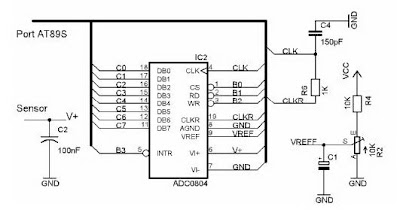
Microcontroller


Mechanical interface microcontroller with ADC 0804
The steps in accessing data from the ADC 0804 by the microcontroller sebgai follows;

Enable ADC with signal 0 at the foot of Chip Select.
Give commands from conversion by providing a low pulse to the foot of the ADC Write narrow
Wait for the ADC issued a signal 0 from his leg INT
Give a moment of time delay for data from the ADC is correct
Give the read command by giving the signal 0 at the foot of ADC Read
Give a moment of time delay
Now data from the ADC is ready for use and if the microcontroller.
Read More

Wednesday, October 22, 2014

ADC 207 Flash Converting

Flash Converting - ADC 207
ADC 207 is the first to use Flash Converting An Advanced High Speed ​​VLSI 1.2 micron CMOS process. The process that is able to do the ADC 207 as mentioned earlier is very great and makes the ADC 207 is unique. The speed of the process of this ADC has a good linearity and have a stable temperature. ADC 207 has a lower power consumption is 250 mW.
ADC is working with +5 VDC voltage source and at a frequency of 20 MHz. ADC 207 has a small sampling time is 12nS, thus making the ideal sampling results. ADC 207 has 128 features auto balanced comparators with each conversion that serves to offset temperature and dynamic effects that exist. Resistor ladder in the ADC 207 has a mid point that is connected to an external voltage source and function in the conversion of 7-bit linearity. ADC 207 has 3 levels of output that is easy to connect it with external components.

ADC 207 Architecture

Feature ADC 207

7-bit flash A / D Converter
Sampling frequency of 20 MHz
Low power consumption (250mW)
VCC 5 VDC
1.2 micron CMOS technology
7 bits with 3 levels of output gates and overflow bits
Read More